Tutorials / Logs or Stats Tutorials
Viewing Logs
CHIME tracks actions completed by users within the system and by the system itself. These logs can help you review past activity, identify which device completed an action, confirm whether a patient was automatically roomed, and investigate why CHIME behaved a certain way at a particular moment.
Accessing Your Clinic’s Logs
To view your clinic’s logs:
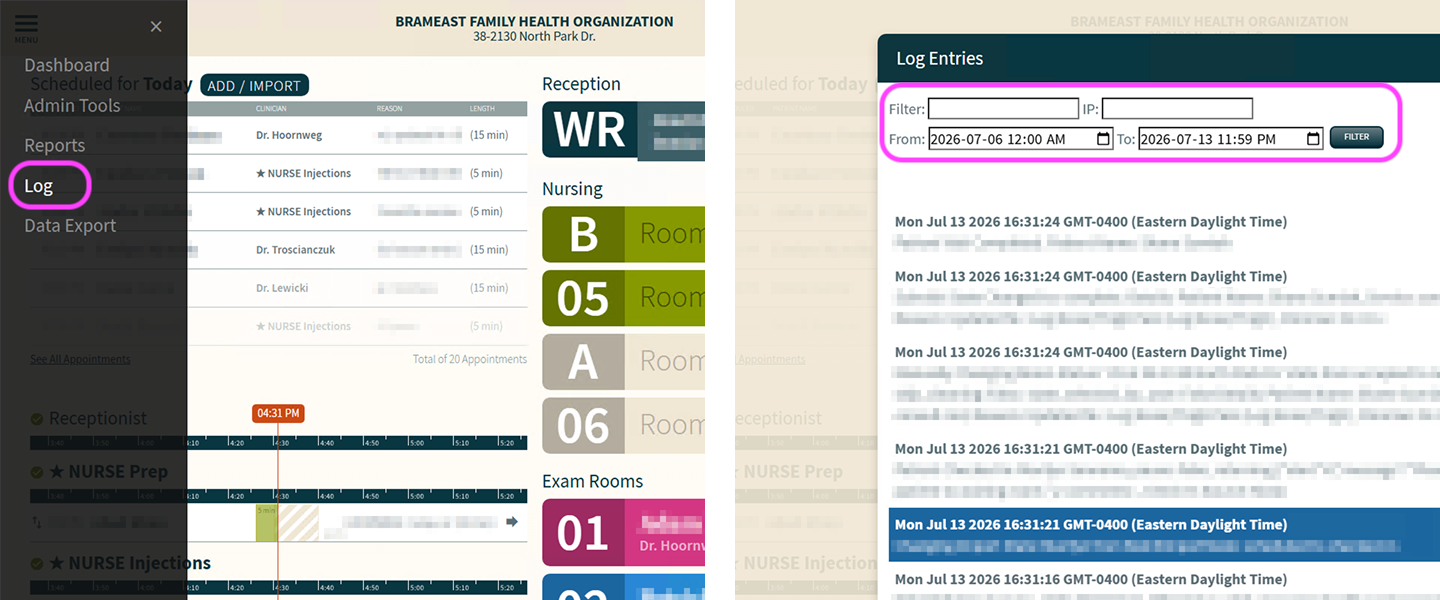
Open the CHIME Dashboard
Click the hamburger menu in the upper-left corner
Click “Log”
The “Log Entries” window displays your clinic’s activity in reverse chronological order, with the most recent entries shown first. You can filter the results using:
Keywords, such as a patient’s name
A specific date or time range
An IP address
After entering your criteria, click Filter to update the results.
Understanding Log Entries
Each log entry describes an action or event recorded by CHIME. Depending on the event, an entry may include:
The patient or appointment involved
The action that occurred or was taken by a staff member / clinician
The time of the action
The IP address of the device that generated it
If the information you need is not available in the logs, contact your CHIME Account Manager. Additional data may be available upon request.
Loading a Previous Clinic State
Some log entries are displayed with a blue background. These entries can be used to load the state of your clinic in CHIME at that point in time. Loading the state allows you to view the CHIME Dashboard as it appeared at a particular moment.
To load a previous state:
Use the instructions above to access the logs
Find a log entry with a blue background
Click that log entry
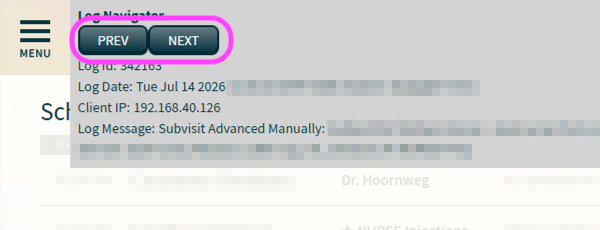
CHIME will open the Dashboard as it was at that specific point in time. You can then use the Prev and Next buttons in the log navigator to move backward or forward through the available saved states.
To exit a previous clinic state simply reload the page and CHIME will load the current state of the clinic.
NOTE : Not every log entry can be loaded. CHIME saves clinic states at selected points rather than after every recorded action as doing so would dramatically degrade CHIME’s performance.
Identifying Who Did What
CHIME does not use per-staff / per-clinician logins. Instead the system logs generally identify actions by the IP address of the device used rather than by an individual staff login.
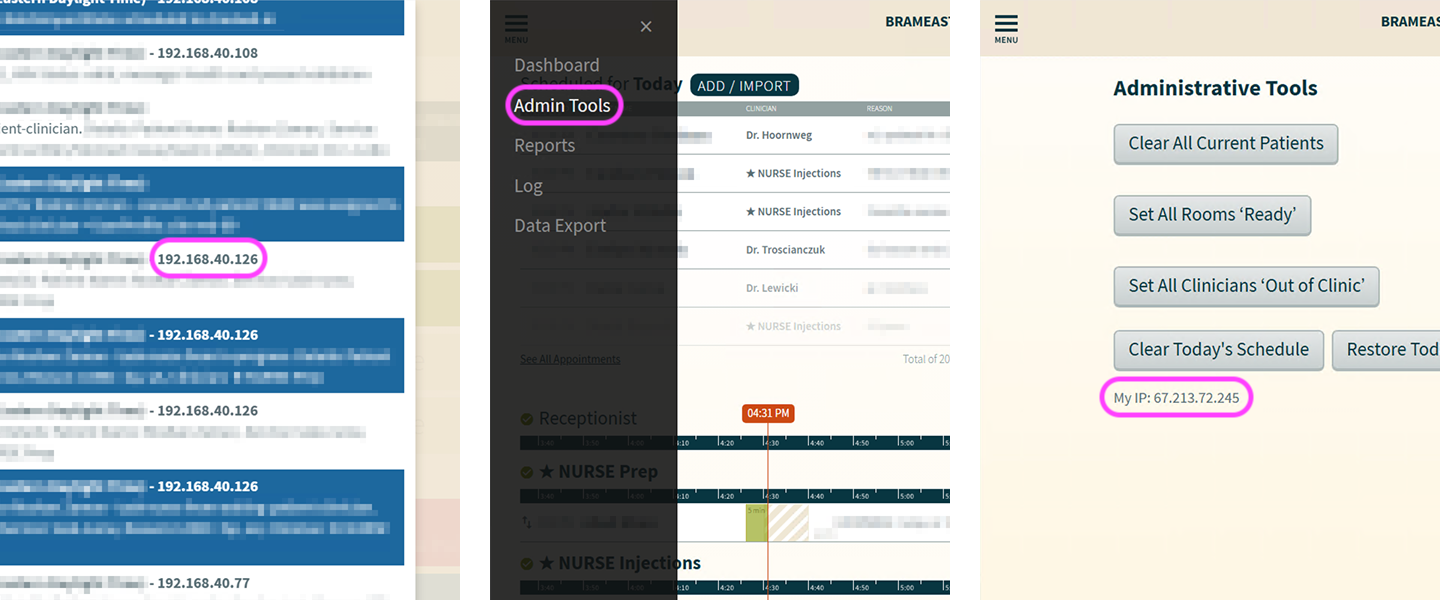
Instead, every log records the IP address of the device / computer that generated the underlying action. Since every device/tablet in your clinic has its own IP address you can use this information to trace back which device/computer was used to perform a specific action.
To find the IP address of the device you are currently using:
Open the CHIME Dashboard
Click the hamburger menu in the upper-left corner.
Click “Admin Tools”
Scroll to the bottom of the page and look for MY IP
For example, if a log states that a patient was manually assigned to Room 01 from IP address 10.87.2.33, you can compare that address with the MY IP value on the clinic’s computers to identify the device/computer that used it.
You can also enter an IP address into the log filters to review actions completed from a particular computer or device.
Reviewing Auto-Rooming Activity
Confirming Patients Were Being Auto-Roomed
You can use the logs to confirm whether CHIME was auto-rooming patients.
Use the instructions above to access the logs
Select the relevant date or time range
Search for the patient, if necessary
Click Filter
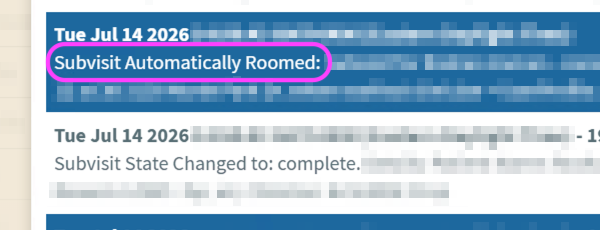
When CHIME automatically rooms a patient, the corresponding entry will include wording such as:
Subvisit Automatically Roomed
If the logs instead show that the patient was manually roomed, the assignment was completed by a user rather than by CHIME’s auto-rooming algorithm.
Understanding Why a Patient Was Not Auto-Roomed
Search the logs for the patient in question and find the entry where they were manually roomed. Click that entry to load the state: this shows CHIME as it was in the moment before the manual rooming took place.
Hover over the patient’s name. The tooltip will explain why CHIME had not auto-roomed them at that point.